
-

Digital Stereo Encoder Starlight
Starlight is a digital stereo encoder for broadcast applications that has been designed using highly innovative technology.
The result is the most advanced that a stereo broadcasting system can offer, with an exceptional array of features.
Besides guaranteeing excellent stereo separation between channels, AEV’s Digital Stereo Encoder ensures a transparency of sound never before reached, whilst maintaining exceptional stability.
Starlight can be installed instantly and can be matched perfectly to any transmission system without calibration.
STEREO CODER
It employs a digital modulator at a sampling rate of 32x that generates frequencies at 19 and 38 KHz for respectively the pilot and subcarrier. The employment of a great quantity of “samples” offers a better spectrum clarity and mantains the MPX signal constant. The stereo separation levels are constantly over 65 dB.
COMPOSITE PROCESSOR:
In order to limit the overshoots, Stargate uses “DSP-Filtering” system composed with a couple of digital low-pass filters, an exclusive AEV “hybrid”, that allows not only a phase linear design, but also dynamically flat responses together with 115 dB/oct slope.
The qualities of this system grant perfect spectrum clarity up to 15 KHz.
At the modulator output another “Safety Clipping” stage removes the remaining overshoots produced by the filters.
CHARACTERISTICS AND FEATURES
-Digital generation of 19 Khz pilot
-Very high pilot stability
-Maximum stereo separation
– Audio distortion non-quantifiable
-Electronically balanced audio inputs
-SCA and RDS signal inputs
-Selectable preemphasis 50 – 75 m S
-19 Khz pilot synchronization
-

AXEL RDS-E5 ENCODER
RDS encoder fully compliant with UECP EBU SPB490 v7.05, CENELEC (Europe) and NRSC (America);
Full support for all RDS services, static and dynamic;
UEPC ports (2 Serial, 4 TCPIP, 4 UDP);
n.8 Data Sets;
n.10 EON + main PS for each Data Set;
Integrated RDS decoder;
FM Tuner with RDS decoder (as option);
Data Set switch managed by UECP/SNMP/REST/HTTP/ASCII PARSER/TXT FILE/GPI;
Easy to interface to any kind of automation system (UECP/SNMP/REST/HTTP/ASCII PARSER/TXT FILE);
RDS can get data from radio automation system (PS/RT/RT+/TA/MS) autonomously;
Easy configuration of RDS page;
RDS 2.0 ready.
-

732 Advanced Dynamic RDS Encoder Inovonics Broadcast
Features:
Supports EAS messages and RDS alerts
- Separate RDS and MPX+RDS outputs for sidechain/loop through
- GPIO assignable (2x in, 2x out)
- Built in the webserver for the control/monitoring of all parameters
- OLED display with easy to navigate menus
- E-mail alerts for pilot loss and DPS/RT not updated. SNMP support.
- IP whitelisting for automation data ports
- Multicast UDP support
- The firmware can be updated remotely via webserver
Specifications:
Supported RDS applications
PS (Program Service Name) An 8-character station “street name” or a 128-character scrolling message (track information, promotions, advertising, etc.).
PI (Program Identification) 732 automatically calculates PI codes for the US and Canada
PTY (Program Type) Identifies the format of your station
Supports EAS messages and warnings on RDS
PTYN (Program Type Name) A further refinement of your programming type or style
TP / TA (Traffic Program / Traffic Announcement) A utility that draws attention to critical traffic or other emergency situations. Some RDS radios automatically tune in to these announcements, even overwriting the playback of CDs or MP3s
AF (Alternative Frequencies) Up to 25 frequency entries for retransmission “translators”.
RT (RadioText) A 64-character block of free-to-air messages that can be called up on the faceplate of some RDS radios. RadioText is separate and in addition to scrolling-PS messages
RT+ (RadioText Plus) An updated standard for displaying song information
CT (Clock Time and Date) The 732 sends the time to RDS radios. The function is automatically set and updated with an Internet connection.
DI (Decoder Information) The mono/stereo data flag
M/S (Music/Speech Switch) The data flag for mixed music or speech only
Scheduler
Up to thirty PS, RadioText messages or commands can be programmed to broadcast at preset times on preset dates or recurring days of the week.
RDS data delay
Scrolling-PS, RT and RT+ message updates can be delayed in 1-second increments of up to 200 seconds to accommodate blasphemy and transmission diversity delays.
MPX or pilot input
An unbalanced, bridged input (BNC) accepts the composite/multiplex (MPX) signal (5V p-p, max.) or 19kHz pilot synchronization of the TTL level from the stereo generator. The 732 returns to an internal crystal time base for monophonic transmissions.
RDS output
An unbalanced 75 ohm BNC (BNC) outputs the RDS subcarrier to power an RDS/SCA input.
RDS + MPX output
The RDS sub-carrier (at 1/3 of the RDS output level) is mixed internally with the MPX input and the combined signal appears at the encoder output at unity gain.
RDS injection level
The sub-carrier level is adjustable from zero to 3.7V p-p.
Data entry on the front panel
The OLED on the front panel and the jog wheel allow the setting of all operating parameters on site.
Serial data port
An RS-232 connector on the rear panel (DB-9) accepts static encoder programming and dynamic station automation messaging. The 732 accepts all common data rates between 300 and 115,200 baud.
LAN port (IP network)
A rear panel network connector (RJ-45) is compliant with TCP/IP network protocols. Two TCP ports and two UDP ports have connectivity from multiple data sources.
A built-in HTTP server provides control and monitoring of all settings. Firmware updates can be uploaded directly to the unit.
SNMP support provides control and monitoring of all settings.
E-mails can be sent for various alarm conditions.
TA switching
The temporary TA flag is set either by a software command or by closing the contacts through a terminal strip on the rear panel. The 732 is equipped with a programmable TA timer utility to prevent violations of the TA flag.
Power Requirements
88VAC-264VAC, 48Hz-63Hz; (‘universal’); 12W
Dimensions and weight
– 23″ x 16″ x 2″ (2U); 8 lbs.
– 584 mm x 406 mm x 51 mm; 3.6 kg
-

703 INOmini RDS ENCODER INOVONICS BROADCAST
- A quick and easy way for useful RDS/RBDS presence
- Scrolling-PS and static Radio Text (up to 128 characters)
- LCD display
- Programmable via USB using Windows® self-guiding software (included)
- Encoder programming is easily confirmed on site without a computer.
- Rapid data transfer allows scrolling messages to be updated within seconds.
- The 703 INOmini can be used with any stereo generator and exciter.
-

5518 OPTIMOD Orban FM Audio Processor e Stereo Encoder
The 5518 includes a full-featured RBS/RBDS generator at no additional charge. The generator supports dynamic PS. It can be controlled via the 5518 presets and an ASCII terminal server that can be connected to automation to support, for example, displaying title and artist.The built-in, defeatable ITU BS412 multiplex power controller acts on all outputs to meet even the most stringent European government regulations include a full spectral protection of subcarriers and RDS/RBDS regardless of the amount of composite limiting.A 10 MHz frequency reference input allows the stereo pilot tone frequency to be locked to GPS or another high-accuracy frequency standard. This improves the performance of single-frequency networks in areas where coverage of the transmitters overlaps.The stereo encoder’s stereo sub-channel modulator can operate in normal double sideband mode and in an experimental compatible single sideband mode (SSB/VSB) that is offered to enable users to compare and assess the two modes.Analog Fallback to Digital control that allows Silence Sense to switch the active input from Analog to Digital if silence is detected in the analog input signal but not on the digital input signal. This function works vice versa as well on both analog and digital AES input.The 5518 can delay its output by as much as 16 seconds. This delay can be used as the diversity delay in Digital Radio installations.At the transmitter side you’ll be pleased by its three separate remote control ports – GPI contact closures, RS232 serial and built-in Ethernet for TCP/IP networks. The serial and Ethernet ports are supported by the supplied 5518 PC Remote Control application. This Windows® 2000/XP/Vista/7/8/10 allows you to access all 5518 features and allows you to archive and restore presets, automation lists, and system setups (containing I/O levels, digital word lengths, GPI functional assignments, etc.)The SNMP (Simple Network Management Protocol) features allow you to monitor your Optimod’s status and to send Alarm notifications via your Optimod’s Ethernet connection to your network. API features allow custom third-party applications (including automation systems) to recall presets, view status and set the controls.
The 5518’s feature set fully exploits the processor’s DSP and computer-based control architecture. To ensure absolute accuracy, you can automatically synchronize the clock to an Internet timeserver. It has a cool-running, energy-efficient switching power supply and uses the latest dual-core DSP chip technology from Freescale Semiconductor.
-
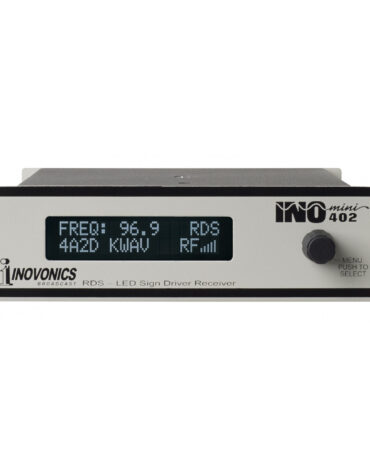
402 INOmini INOVONICS BROADCAST DRIVER LED SIGNAL
Features
- View and export PS (Program Service) and RT (Radio Text) messages
- Supports the most popular LED signage formats
- Tuning from 64MHz – 108MHz in 100kHz steps
- Provides support for those who choose colors and fonts
- Front panel display of RDS presence, Signal Strength, PI Code, RT, PS and more
Specifications
Tuning range
64.0MHz – 108.0MHz in 100kHz steps
Receiver sensitivity
10μV for a solid text display
Antenna input
The 75 ohm input (‘F’ connector) can accept downlead from the rooftop antenna, a simple two-wire dipole or random wire, depending on signal strength and reception conditions.
LED signal output
DB9 male and female serial data connectors; the communication baud rate is automatically set when the sign type is selected.
*LED Sign sold separately
Supported signature protocols
Supplied by Inovonics-; NEOPlex Technology; Alpha
Characters and colors
The options are selected via the 402 menus, depending on the capabilities of the sign used.
402 Power Requirements
12VDC at 125mA. A “brick type” (inline) switching power supply is provided to match the target AC mains voltage.
Mounting options
An optional rack adapter accepts up to three INOmini modules in a 1U, 19″ rack space, or the 402 can be easily attached to any convenient surface with two small screws.
Dimensions and weight
1.6 “H x 5.5 “W x 5.5 “D; 4 pounds shipping weight
-

YAMAHA HS 5I ACTIVE STUDIO MONITOR
Active 2-way near-field monitoring
Equipped with: 5″ woofer (45 W) + 1″ tweeter (25 W)
Power: 70 Watt bi-amp
Bass reflex system
Frequency range: 54 – 30,000 Hz
Balanced XLR input
Balanced 6.3 mm jack input
Adjustable input level
Chamber control and high voltage equalizer
Mounting points on 4 sides
Dimensions: 170 x 285 x 222 mm
Weight: 5.5 kg
Color: Black
More information
Speaker size 1x 5″
Amplifier power per unit (RMS) 70 W
Magnetically Shielded No
Analog XLR Input Yes
Analogue Input (Jack) Yes
Analogue Input (Mini Jack) No
Analogue Input (RCA) No
Digital Input No
Manual Frequency Correction Yes
-
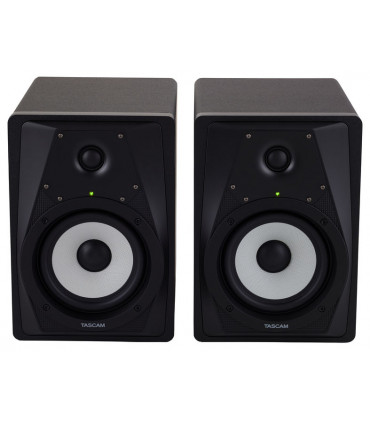
TASCAM VL-S5 AMPLIFIED STUDIO MONITOR
Active 2-way studio monitors
Equipment: 1″ tweeter, 5 1/4″ woofers.
Output power: 30 W tweeter, 40 W woofer
Frequency range: 60 – 22000 Hz
Bass reflection
Magnetically shielded
Crossover frequency: 3.2 kHz
Connections: XLR /jack input (balanced / unbalanced)
Dimensions (W x H x D): 176 x 255 x 200 mm
Weight: 5.4 kg
Delivery unit: 1 pair
Further information
Speaker size 1x 5.25″, 1x 1″
Amplifier power per unit (RMS) 70 W
Magnetically shielded Yes
Analogue XLR input Yes
Analogue Input (Jack) Yes
Analogue Input (Mini Jack) No
Analogue Input (RCA) No
Digital Input No
No Manual Frequency Correction
-

TANNOY REVEAL 502 Active studio monitor
Features
Frequency Response: 49Hz – 43kHz
Max SPL: 108dB
LF/Mid Range Drive Unit: 5″ (130mm)
HF Drive Unit: 1″ (25mm) Soft Dome
LF/Mid Range Power: 50 Watt RMS
HF Power: 25 Watt RMS
THD: < 0.7%
Balanced Input: XLR, 20 kOhm
Unbalanced input: 1/4″ Jack, 10 kOhm
AUX Link: 1/8″ Jack, 10 kOhm
AUX Link output: 1/8″ jack
HF EQ Settings: -1.5dB HF Cut / Neutral / +1.5dB HF Boost
Crossover Frequency: 2.3kHz
Dimensions: H300 x 184 x 238mm
Weight: 7.2kg
-
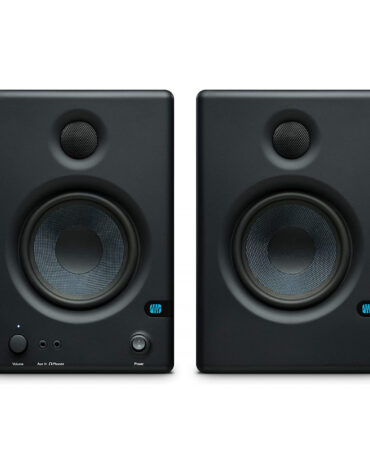
PRESONUS ERIS 4.5 Active Speakers
Features
4.5″ (115mm) composite low-frequency transducer
Ultra-low-mass 1″ (25mm) high-frequency transducer with silk dome
Acoustic port with rear focus for superior low-frequency reproduction
Optimized internal reinforcement that suppresses resonance
High and low frequency adjustment controls
Front-panel volume control for speakers and headphone amplifier
Bluetooth pairing button
50 watts (25 W/side), Class AB bi-amping
Protection from RF interference, output current limiting, overheating, transients and subsonics
Amplifier’s “soft start” function eliminates pops at power-up
Internal power supply with IEC connector
Power switch with On / Off LED
Bluetooth 5.0 stereo wireless input
Balanced 1/4″ TRS, 1/8″ unbalanced and RCA inputs
Built-in stereo headphone amplifier with 1/8″ output on front panel
Dimensions: 163 x 180 x 241mm
Weight (per pair): 5.9kg
-

JBL Control 1Pro pair of passive studio monitors
Pair of 2-Way Small Loudspeakers with Wall Mount
Power rating: 150 W
Impedance: 4 Ohm
Plastic housing
MU Metal shielding
Speaker terminals
Dimensions: 235 x 159 x 143 mm
Weight: 1.8 kg
Colour: Black
Wall mount included
Compatible microphone stand adapter available at Article Nr 204382 (optional)
Weight: 1.8 kg
Note: Price for pair (2 pcs)
Suitable bag: Art.489449 (not included)
-

JBL 305P MKII Studio Monitor with Active Speaker
Active near field monitoring
Equipment: 5″ woofer and 1″ tweeter
2-way Class D amplifier 82 watts – 41 watt woofer and 41 watt tweeter
Frequency response (+/- 3dB): 49 – 20,000 Hz
Maximum level: 108 dB
Adjustable input sensitivity +4 dBu / -10 dB
Perimeter equalizer
HF trim switch
Balanced XLR and 6.3 mm line inputs
15 mm MDF enclosure
Dimensions (HxWxD): 298 x 185 x 231 mm
Weight: 4.73 kg
Price per piece
More information
Speaker size 1x 5″
Amplifier power per unit (RMS) 82 W
Magnetically shielded Yes
Analogue XLR input Yes
Analogue Input (Jack) Yes
Analogue Input (Mini Jack) No
Analogue Input (RCA) No
Digital Input No
Manual Frequency Correction Yes